
Negligence Per Se in Florida Injury Cases
Quick Summary: In Florida personal injury law, negligence per se occurs when a defendant violates a statutory law designed to protect a specific class of individuals from a specific type of harm. Established by the Florida Supreme Court in deJesus v. Seaboard Coast Line Railroad Co., proving negligence per se shifts the legal focus from proving duty and breach to proving causation and damages.
What Is Negligence Per Se Under Florida Law?
In a standard personal injury claim, the plaintiff must prove four fundamental elements: Duty, Breach, Causation, and Damages.
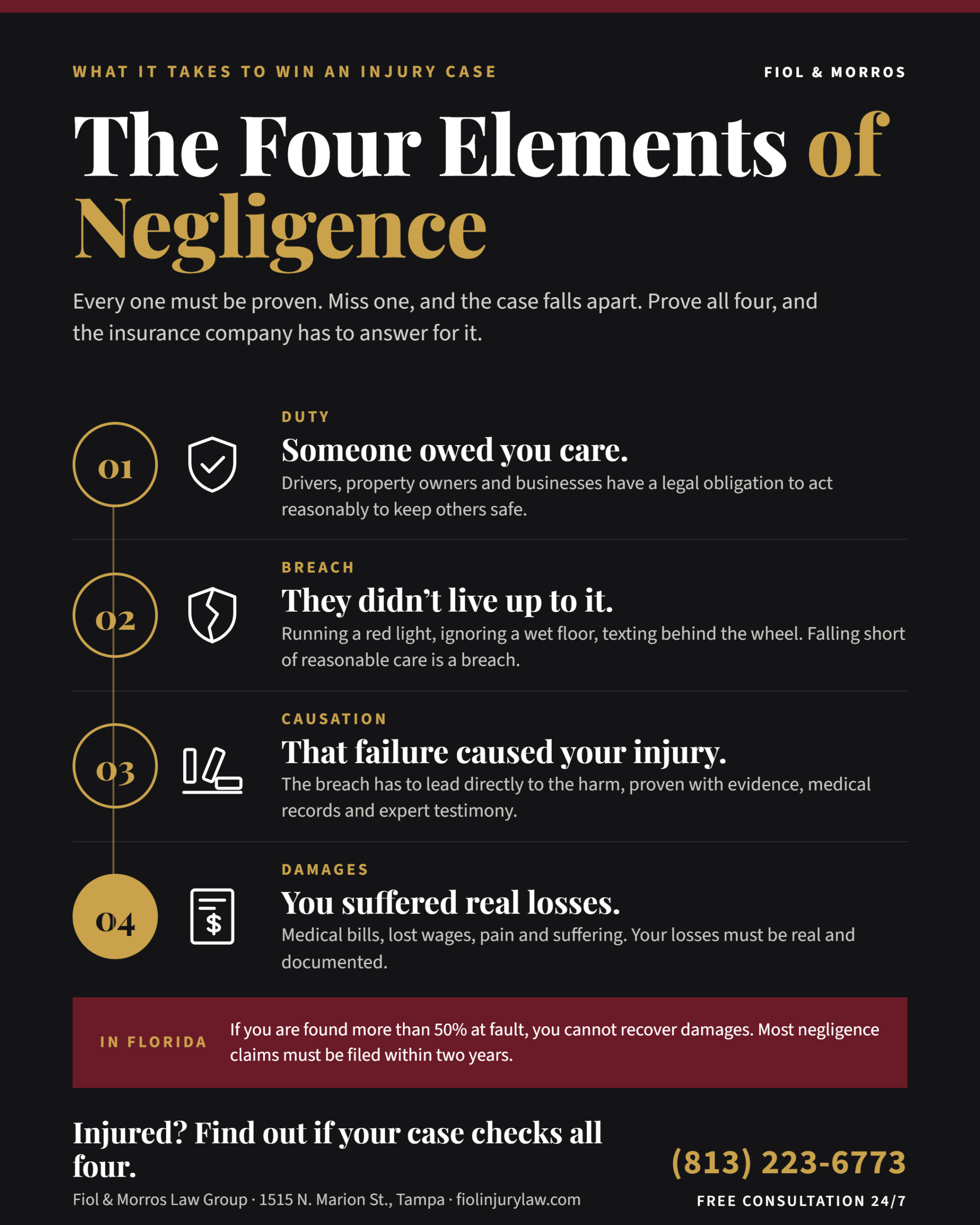
Under the doctrine of negligence per se, the court accepts the violation of a statute or safety ordinance as automatic proof that the defendant breached their legal duty of care. Instead of debating whether a defendant acted as a "reasonably prudent person" would, the plaintiff simply establishes that the defendant broke a specific law enacted for safety.
Legal Principle: When an individual violates a statute explicitly crafted to prevent a specific type of injury to a specific group of people, the law presumes breach of duty as a matter of law.
The 4-Part Florida Test (deJesus v. Seaboard Coast Line Railroad Co.)
To establish negligence per se in a Florida court, an injured party must satisfy the multi-element test outlined by the landmark Florida Supreme Court case deJesus v. Seaboard Coast Line Railroad Co., 281 So. 2d 198 (Fla. 1973):
- Statutory Violation: The defendant violated a specific law, statute, or penal ordinance.
- Protected Class: The injured victim belongs to the specific class of persons the statute was enacted to protect.
- Protected Harm: The injury suffered was the exact type of harm the statute was designed to prevent.
- Causation: The violation was the proximate cause of the victim's resulting injuries and economic loss.
Strict Negligence Per Se vs. "Evidence of Negligence" in Florida
Florida law makes a clear distinction between statutes that trigger strict negligence per se and those that merely serve as evidence of negligence:
| Classification | Legal Standard | Common Florida Examples | Impact on Lawsuit |
|---|---|---|---|
| Strict Negligence Per Se | Violation of penal statutes or laws designed to protect a vulnerable class. | Selling alcohol to minors (Fla. Stat. § 562.11); building code violations causing collapse; child labor law violations. | Breach is conclusively established as a matter of law. |
| Evidence of Negligence | Violation of general traffic regulations or ordinary safety statutes. | Speeding (Fla. Stat. § 316.183); running a stop sign (Fla. Stat. § 316.074); failure to yield right-of-way. | Jury considers the statutory violation as evidence when determining fault. |
Common Examples in Tampa Personal Injury Litigation
Our Tampa injury lawyers frequently leverage statutory violations across various practice areas to establish liability:
- DUI Accidents (Fla. Stat. § 316.193): Driving under the influence violates a strict criminal statute designed to protect fellow motorists from alcohol-impaired collisions. In car accident claims, a DUI arrest can be powerful proof of fault.
- Nursing Home Abuse (Fla. Stat. Chapter 400): Assisted living facilities that breach mandated staff-to-resident ratios or medical reporting rules violate safety standards created specifically for vulnerable seniors. Our Tampa nursing home abuse lawyers use these violations to hold facilities accountable.
- Dog Bites (Fla. Stat. § 767.04): Florida applies strict liability for dog owners, making failure to secure a dangerous animal an immediate basis for liability in a dog bite claim.
How Florida's Modified Comparative Fault Law Applies
Under Florida's updated modified comparative fault standard (Fla. Stat. § 768.81), a finding of negligence per se against the defendant does not automatically end the case.
If the defense argues that the plaintiff contributed to their own injuries, damages are reduced by the plaintiff's percentage of fault. Furthermore, if a plaintiff is found to be more than 50% responsible for the incident, they are barred from recovering damages under Florida law.
Frequently Asked Questions
What is negligence per se under Florida law?
Negligence per se is a legal doctrine where a defendant's violation of a safety statute or penal law automatically establishes a breach of duty, removing the need to independently prove that the conduct was unreasonable.
Does getting a ticket at the scene make the other driver automatically liable?
While a traffic citation strongly supports your case, ordinary traffic infractions are categorized as "evidence of negligence" in Florida, rather than automatic negligence per se. A judge or jury weighs the citation alongside other accident evidence.
What must I prove after establishing negligence per se?
You still must prove proximate cause and damages. You must show that the statutory violation directly caused your physical injuries, medical bills, lost wages, and pain and suffering.
Speak with a Tampa Personal Injury Attorney Today
Navigating statutory duty and liability rules requires deep legal knowledge. If you were injured due to someone else breaking the law in Hillsborough County, Fiol & Morros Law Group can help.
Call our Tampa legal team today at (813) 223-6773 or visit 1515 N Marion St, Tampa, FL 33602 for a free consultation.
Related reading: Do You Need to Replace a Car Seat After an Accident?







 English
 Español